

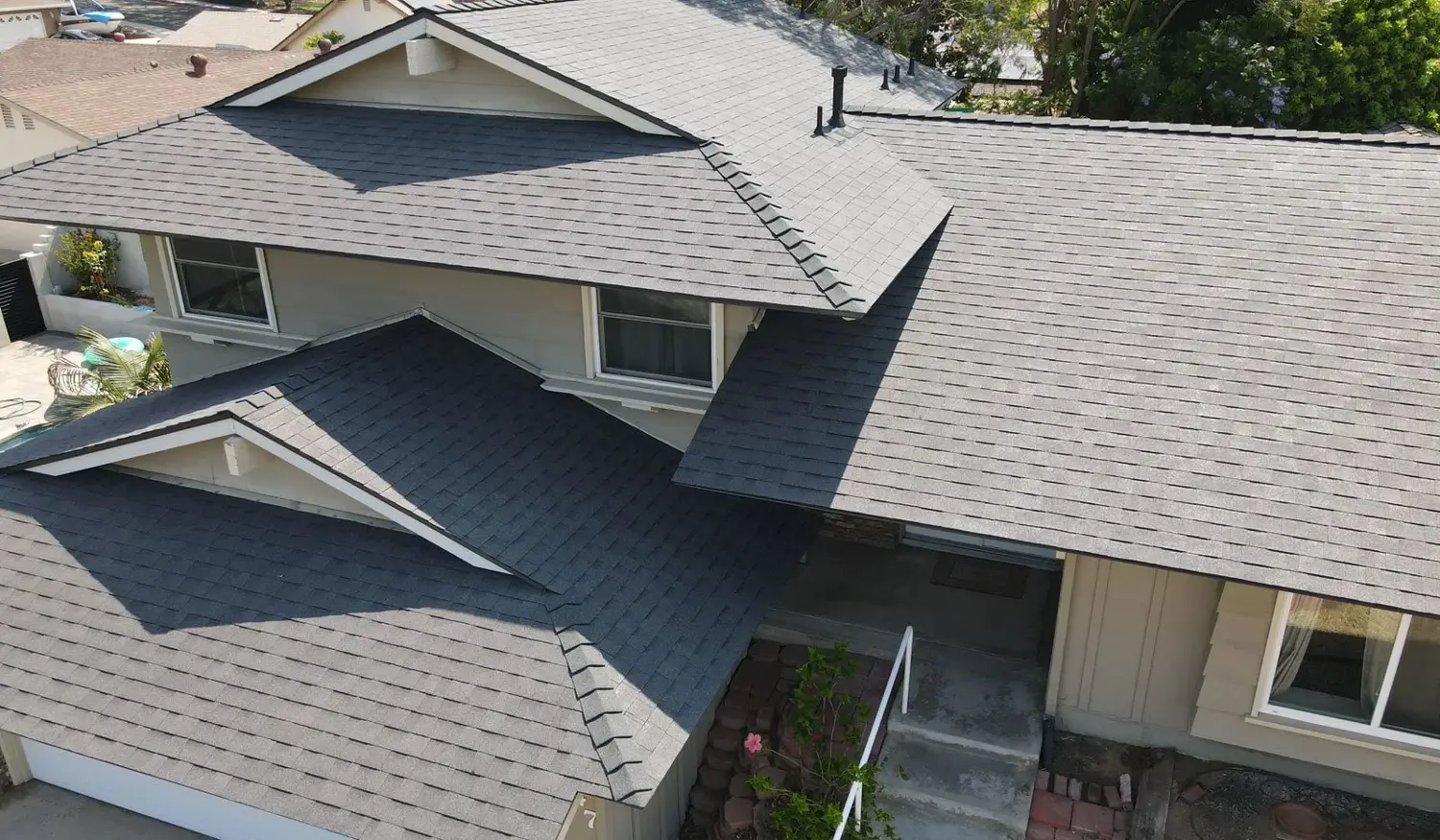
What Causes Shingles to Curl, Crack, or Fall Off?
Shingles that curl, crack or blow off are not just a cosmetic issue. Each problem has a short list of causes, and the cause decides whether a repair will hold or the roof is telling you it is near the end.
Schedule Your Roofing Inspection Today
Fill out the information below and we’ll reach out to complete your estimate as soon as possible!
How an asphalt shingle is supposed to work
An asphalt shingle is a fiberglass mat coated with asphalt and covered with ceramic granules. The granules block the sun. The asphalt keeps water out and gives the shingle some flexibility. A strip of sealant on the underside bonds each shingle to the one below it, so wind cannot get under the edge.
Over time, heat and UV slowly dry out the asphalt. As it loses its oils, the shingle shrinks, stiffens and becomes brittle. That process is normal, but several things can speed it up: a hot, poorly ventilated attic, installation mistakes, or storm damage. When you see curling, cracking or missing shingles, the question is which of those is behind it.
Texas heat plays a large part in this story. Our article on how Texas heat affects asphalt shingles explains the aging process in more depth. Here we focus on reading the symptoms.
Two less obvious causes are worth knowing. The first is a roof-over, where new shingles were nailed on top of an old layer. The new shingles sit on an uneven, hotter surface and often curl or crack sooner. The second is a batch problem: shingles that shed granules or lose their seal early across the whole roof, in a pattern that has nothing to do with sun exposure or storms. If your roof is fairly young and shows widespread trouble, ask the inspector to consider both.
Curling: cupping vs clawing
Cupping
The edges of the shingle turn up and the middle sinks, like a shallow dish. It often points to a hot attic, moisture under the shingles or simple age.
Clawing
The edges stay down and the middle rises in a hump. It is often linked to moisture in the deck or to shingles that were not installed properly.
Curling on one slope
If only the sunniest slope curls, heat and UV are the main suspects. If the whole roof curls, look at age and ventilation.
Curling in patches
Isolated areas can point to a single installation issue, a soft spot in the deck or a localized moisture problem below.
Why shingles crack
Cracks come in two main kinds. Thermal cracking shows as splits that run across the shingle, often in a pattern across the whole roof. It happens when brittle, aged shingles expand in the afternoon heat and contract at night, day after day. Once a roof shows widespread thermal cracking, the shingles have usually lost most of their flexibility.
Impact cracking looks different. It is random, often circular or star-shaped, and concentrated on the slopes that faced a storm. That points to hail. Our guide on how to identify hail damage on asphalt shingles shows how to read those marks.
A third type, splitting along a straight line, can come from movement in the deck below or from shingles that were installed over a surface that was not flat.
Why shingles fall off
Shingles usually come off because the bond that holds them down has failed. The sealant strip can lose its grip with age, or never bond properly if the shingles were installed in cold weather and did not see enough sun afterward. Once the edge is loose, wind can lift and crease the shingle until it tears.
Nailing is the other big factor. Shingles have a marked nailing zone. Nails placed too high, too few nails, or nails driven at an angle leave the shingle with less hold. That kind of mistake may not show for years, then a strong storm strips off a section. Our article on whether Texas winds can lift shingles explains how wind damage builds up quietly.
Hail can also play a part. Impacts near the edge of a shingle can crack the sealant bond, which leaves that shingle open to the next windstorm.
Missing shingles are more urgent than curled or cracked ones. A gap in the roof exposes the underlayment, which is not designed to face sun and rain on its own for long. Nails that held the old shingle can also leave open holes. If you find shingle pieces in the yard after a storm, have the roof checked before the next rain rather than waiting for a stain.
A ground-level checklist for shingle problems
Use binoculars from several angles
Look at each slope in morning and afternoon light. Curling and lifted edges show best when the sun is low.
Count and locate
Note whether the problem is on one slope, in one area, or everywhere. That pattern points to the cause.
Check the gutters
Heavy granule buildup, especially with pieces of shingle, means the surface is breaking down.
Look for shingles in the yard
Any piece of shingle on the ground after wind is a sign that more may be loose.
Feel the attic heat
If the attic is extremely hot on a summer afternoon and the vents look blocked, ventilation may be aging your shingles.
Photograph what you see
Dated photos help a roofer and give you a baseline for the next check.
What the cause means for your options
A few shingles blown off a roof in good shape: usually a straightforward repair.
Curling or cracking in one small area: repair the area and check the deck and ventilation below.
Curling or thermal cracking across the whole roof: the shingles are near the end of their life, and repairs will not slow that down.
Repeated blow-offs on different slopes: look at nailing and sealant across the roof before paying for more spot repairs.
Hail cracks: an inspection and photos come first, then a repair or replacement plan.
Repair or replace?
Age is the tiebreaker. U.S. Census ACS 2020-2024 estimates put the median year built of homes in San Antonio at 1985 and in Garland at 1978. Many of those homes are on their second or third roof, and a roof that is already curling everywhere is often a candidate for replacement rather than another patch. Our guide to roof repair vs replacement walks through that decision.
If you replace, it is a chance to fix the causes too: better attic ventilation, correct nailing, and a shingle that fits your home. GemSco is family owned, fully licensed and insured, and an elite contractor for Owens Corning and GAF, with more than 20 years of experience. We inspect, photograph what we find and give you a written estimate. See our asphalt shingle roofing page or call (844) 980-5506 for a free estimate.
Frequently Asked Questions
Is curling always a sign that I need a new roof?
Not always. A few curled shingles in one area can come from a local moisture or installation issue and can be repaired. Curling across most of the roof usually means the shingles have aged out. An inspection that looks at the attic and the deck helps tell which case you have.
Can poor attic ventilation make shingles curl?
Yes. A hot, humid attic heats the shingles from below as well as from the sun above, which dries out the asphalt faster. Moisture trapped under the deck can also distort it. Fixing ventilation is often part of a lasting solution.
Why did only a few shingles blow off in the last storm?
Usually because those shingles had a weaker hold: a sealant strip that never bonded, nails placed outside the nailing zone, or an exposed position on the roof. If more shingles come off in later storms, the problem may be wider than a few spots and worth a full inspection.
Can cracked shingles be repaired?
Individual cracked shingles can often be replaced if the surrounding shingles are still flexible. If the cracking is widespread from heat and age, nearby shingles may break during the repair, and replacement becomes the more practical option. An inspector can test how flexible the shingles still are before recommending either path.
We’re Here to Help!
GemSco Roofing & Solar serves Houston, DFW, Austin, San Antonio and surrounding areas. We’re family owned and fully licensed and insured.