

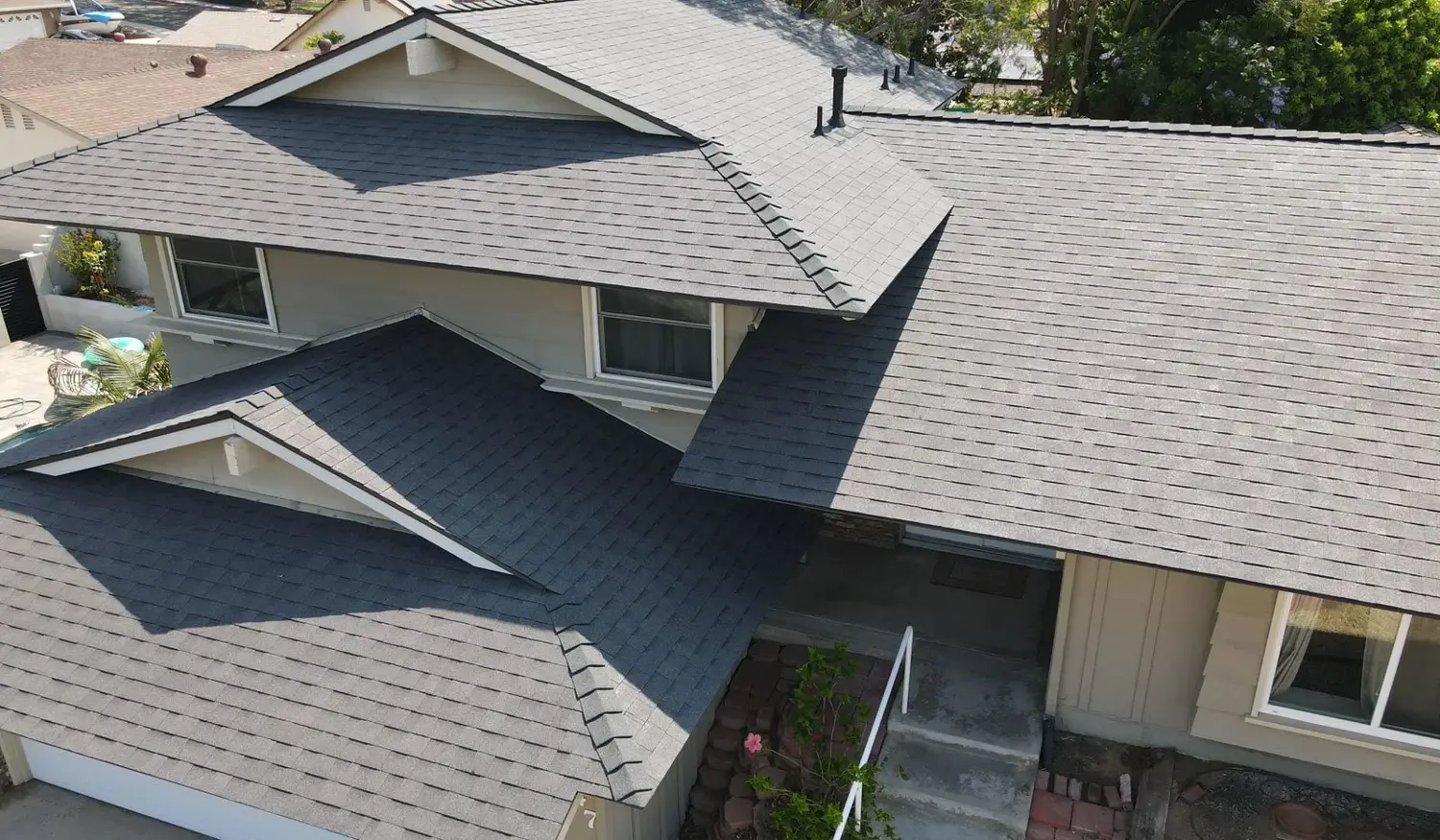
What is drip edge on a roof, and how do you know if yours is missing?
Drip edge is a thin, bent strip of metal nailed along the edges of a shingle roof. It carries water past the fascia and into the gutter instead of letting it soak the wood at the roof's edge. On shingle roofs built to the residential code, it is required, not optional.
Schedule Your Roofing Inspection Today
Fill out the information below and we’ll reach out to complete your estimate as soon as possible!
What drip edge does, in plain terms
Rain runs down your shingles and reaches the edge of the roof. Without anything there, water clings to the bottom of the shingles, curls back under them and runs down the fascia board, the trim your gutter hangs on. Drip edge is the metal lip that breaks that path. It holds the water away from the wood so it falls into the gutter.
It does a second job most people never hear about: it covers the raw edge of the roof deck. The deck is the plywood or OSB under your shingles. Its edge soaks up water like a sponge, and a wet edge rots, loosens the nails that hold the first rows of shingles, and gives wind an easier place to start peeling.
You will find drip edge in two places. The eaves are the bottom edges, where the gutters hang. The rakes are the sloped side edges at the gables. Both get a strip, and they are installed differently, which matters more than it sounds.
What the code says about drip edge in Texas
Texas cities use the International Residential Code as their base. State law makes the IRC the municipal residential code and lets each city adopt amendments, so the exact rule depends on the edition and changes your city adopted.
Drip edge became a code requirement for asphalt shingles in the 2012 IRC. The ICC's summary of that edition's changes notes that before it, drip edge was only required when the shingle manufacturer called for it.
The Texas Department of Insurance spelled out the 2018 IRC rule in its July 2022 engineering newsletter: drip edge at eaves and rake edges of shingle roofs, pieces overlapped at least two inches, the vertical leg reaching at least 1/4 inch below the sheathing and running at least two inches up the slope, and the strip fastened to the deck.
The same TDI newsletter adds a detail many crews skip: the thickness of the fascia and any extra wood trim change the profile the drip edge needs. A strip that fits one house can leave a gap on another.
Eave vs rake: the layering that keeps water out
At the eaves: drip edge first
The metal goes on the deck, and the underlayment laps over it. Water running down the underlayment lands on top of the metal and drains off.
At the rakes: underlayment first
The underlayment goes on, and the drip edge goes over it. Wind-driven rain hitting the side edge stays on the outside of the felt.
At the corners
Where a rake meets an eave, the pieces have to lap in the direction water flows. A reversed lap sends water behind the metal.
The shingle overhang
Shingles sit on top of the drip edge and extend a little past it, so water drips clear of the metal and into the gutter.
How far the shingles should hang past the metal
Too little overhang and water runs back over the metal and under the shingles. Too much and the edge has nothing under it. GAF's technical bulletin on drip edges and shingles calls for shingles to extend at least 3/8 inch over the drip edge at eaves and rakes.
The same GAF bulletin warns that when shingles hang more than 3/4 inch past the drip edge, they are unsupported, can crack and break off, and the roof edge can lose wind resistance. That matters in Texas, where storms hit the edges first. If you have seen shingles missing along the edge after a storm, read whether Texas winds can lift shingles.
The bulletin also calls for a non-corroding metal, such as aluminum or galvanized steel, and points installers to the instructions printed on the shingle wrapper. Every brand has its own, so ask your roofer which ones they are following.
How to check your drip edge from the ground in 10 minutes
Look at the roof edge from the yard
You should see a thin metal edge between the bottom row of shingles and the fascia. If the shingles seem to end right on the wood, the drip edge may be missing.
Check the gables too
Look at the sloped side edges. Missing rake drip edge often shows as darker, swollen wood along the top of the trim board.
Read the fascia paint
Peeling paint, dark streaks or warped boards right behind the gutter are the classic sign of water getting behind it.
Look up at the soffit
Stains or mildew on the underside of the eaves, especially near gutter corners and downspouts, point to water traveling behind the gutter.
Watch during the next rain
If water runs down the face of the fascia or drips between the gutter and the house, the edge is not doing its job.
Check the attic edges
With a flashlight, look where the roof deck meets the outside walls. Dark, stained wood at the very edge means water has been getting in for a while.
What happens when a roof has no drip edge
Nothing dramatic at first, which is why it gets skipped. Water wicks into the fascia and the edge of the deck a little each storm. Paint fails first. Then the wood stays wet long enough to rot, and the gutter screws lose their grip in soft wood. Gutters that pull away from the house are often a rotten fascia problem, not a gutter problem.
Rot at the deck edge is worse because you cannot see it from the yard. The first rows of shingles are nailed into that wood. Once it softens, the nails hold less and the edge is the first place wind gets a grip. That is also how a small edge problem turns into the kind of leak that shows up in heavy rain.
If the fascia is already soft, adding metal later stops new water but does not fix the damaged wood. The rotten board has to be replaced first, then the edge sealed. A roof repair can handle a short section; a full edge usually makes more sense to fix during a replacement.
What to ask before you sign a roofing estimate
Is new drip edge included at both the eaves and the rakes, and is it listed as a separate line item?
Will you reuse the old drip edge? Bent, rusted or painted-over metal usually should not go back on.
What metal will you use, and what color? Matching the trim matters if you care how the edge looks from the street.
Which goes first at the eaves, the drip edge or the underlayment, and why?
What happens if the crew finds soft fascia or rotten deck edges once the old roof is off, and how is that priced?
Does the drip edge work with my gutters, or will they need a gutter apron or an adjustment?
Drip edge and your gutters
Drip edge only works if the water lands in the gutter. A gutter hung too low, or pulled away from the fascia, leaves a gap where water falls behind it anyway. Some roofs use a gutter apron at the eaves, a flashing that reaches down into the gutter itself, instead of or in addition to a standard drip edge.
If your gutters overflow, sag or drip from behind, check them before blaming the roof. Loose hangers and soft fascia often show up together. A gutter repair and a roof edge repair are frequently the same visit.
If you are planning a new roof anyway, drip edge is one of the details worth reading line by line. Our guide on what to include in a roof replacement estimate covers the other items that get left out of cheap bids, and why roof underlayment matters explains the layer drip edge works with.
Frequently Asked Questions
Is drip edge required on a roof in Texas?
On shingle roofs, the residential code most Texas cities use requires drip edge at the eaves and rake edges. It was added to the IRC in the 2012 edition. Your city adopts its own edition and amendments, so check with the local building department for the exact rule where you live.
Does drip edge go over or under the underlayment?
Under the code text summarized by the Texas Department of Insurance, the underlayment goes over the drip edge at the eaves and under the drip edge at the rake edges. The idea is the same in both places: every layer laps so that water flows over the next one, never behind it.
Can drip edge be added to an existing roof?
Yes, but it is fiddly. The installer has to slide the metal under the first course of shingles without breaking their seal, which is harder on older, brittle shingles. It is usually cleaner and easier to add during a roof replacement. If the fascia is already soft, that wood has to be replaced first.
What is the difference between drip edge and a gutter apron?
Both are metal flashings at the roof edge. Standard drip edge kicks water away from the fascia. A gutter apron reaches down into the back of the gutter so water cannot slip behind it. Some roofs use an apron at the eaves and drip edge on the rakes.
Is a missing drip edge a reason to replace the whole roof?
Not by itself. If the shingles are in good shape, the edge can often be repaired. If there is widespread rot along the deck edge, or the roof is near the end of its life, it usually makes more sense to install drip edge as part of a replacement.
Keep Reading
We’re Here to Help!
GemSco Roofing & Solar serves Houston, DFW, Austin, San Antonio and surrounding areas. We’re family owned and fully licensed and insured.