

Why Roof Leaks Often Appear Around Chimneys and Vents
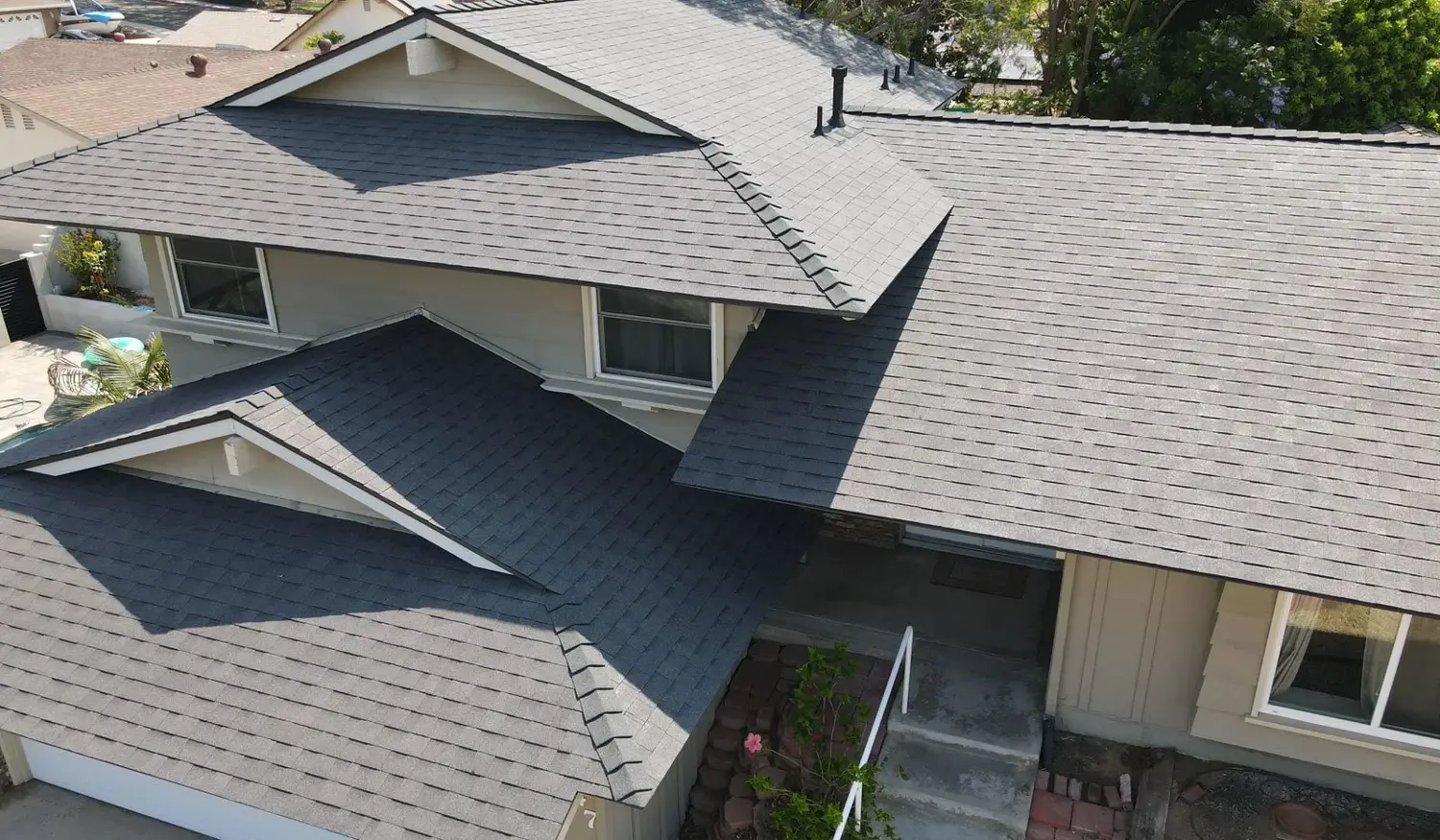
Every chimney, pipe and vent is a hole cut through your roof on purpose. Each one relies on a seal that sits in the sun, moves with the house and handles all the water running down the slope above it.
Schedule Your Roofing Inspection Today
Fill out the information below and we’ll reach out to complete your estimate as soon as possible!
Why penetrations are the weak spots
A sloped roof works because water runs over overlapping layers from the ridge to the gutter. Anything that sticks up through those layers interrupts the flow. Water hits the uphill side of the chimney or vent, pools for a moment and looks for a way around. If the seal there is cracked, loose or poorly lapped, it goes in.
These seals are also the parts that age fastest. Rubber boots and sealants break down in UV and heat long before the shingles do. A roof that is otherwise in good shape can leak for years at one vent while everything else holds.
Penetrations are a subset of the causes covered in our guide to the 8 common causes of roof leaks in Texas homes. This article looks at them one by one.
Solar panels add penetrations too. Every mount that is bolted through the roof needs its own flashing, and it sits under the panels where it is hard to see. If your roof needs work under an existing array, the panels usually have to come off first. Our solar panel removal and reinstallation page explains that process.
Where chimneys leak
Base flashing
The metal that wraps the chimney where it meets the roof. Gaps, rust or lifted edges let water run straight to the deck.
Counterflashing
The piece set into the mortar joints that covers the base flashing. When the mortar cracks or the metal pulls out, water gets behind it.
Missing or small cricket
Wide chimneys need a small peaked structure on the uphill side, called a cricket or saddle, to split the water. Without it, water and debris pile up there.
Masonry and crown
Brick and mortar absorb water. A cracked crown on top of the chimney or worn mortar joints can let water inside the chimney itself.
Chimney cap
A missing or damaged cap lets rain fall straight down the flue or chase.
Where vents leak
Plumbing pipe boots
The rubber collar around each plumbing vent dries, cracks and pulls away from the pipe in the Texas sun. It is one of the most common leak sources.
Box and turbine vents
Attic vents have a metal or plastic base that sits under the shingles. Cracked housings, missing nails or bad laps let water in.
Exhaust fan vents
Bathroom and kitchen exhaust caps can crack or lose their seal, and dampers that stick open let wind-driven rain in.
Ridge vents
Poorly installed or damaged ridge vents can let rain blow in along the peak during strong storms.
Skylights
Not a vent, but the same problem: flashing kits, frame seals and the curb all have to work together.
Roof leak or chimney leak?
Not every leak near a chimney is a roof problem. If water appears inside the fireplace, in the firebox or on the inside face of the chimney, the source may be the crown, cap or masonry, which are part of the chimney itself. A stain on the ceiling next to the chimney, or on the attic deck around it, points more toward the flashing where the chimney meets the roof.
The difference matters because the fix is different. Flashing is roofing work. Rebuilding a crown or repointing brick is masonry work. A good inspection checks where the water is actually entering before anyone recommends a repair. If the leak only appears in big, windy storms, it may be coming in at the counterflashing or through the masonry above the roof. Our article on flashing that is failing shows what to look for there.
Checklist: inspecting chimneys and vents
Count your penetrations
From the ground, list every chimney, pipe, vent and skylight on the roof. Each one is a potential leak point.
Check the boots
With binoculars, look for cracked, split or shrunken rubber around plumbing pipes and gaps between the boot and the pipe.
Check the chimney flashing
Look for lifted metal, rust, gaps at the mortar joint and missing sealant.
Look uphill of each one
Debris, leaves or granules piled on the uphill side mean water is pooling there.
Check the attic below each
On a dry day after rain, look at the wood around every penetration for dark marks or damp insulation.
Note what is changing
Take dated photos each season. A stain that grows tells you the seal is still letting water in.
Habits that keep penetrations dry
Have every pipe boot and vent checked during routine inspections, not only the shingles.
Keep the uphill side of chimneys and skylights clear of leaves and branches.
Make sure bathroom and kitchen fans vent through the roof or wall, not into the attic.
Do not let anyone mount a satellite dish or antenna through the shingles without proper flashing.
After hail, ask the inspector to look closely at vent caps and metal flashing, which dent easily.
Plan to replace old boots and flashing during a roof replacement instead of reusing them.
What a lasting repair looks like
For pipe boots, the lasting fix is a new boot installed under the shingles above it and over the shingles below it, so water runs over it, not behind it. A bead of sealant around a cracked boot is a short-term patch at best. For box vents and exhaust caps, replacing a cracked housing and restoring the shingle laps around it usually solves the problem.
For chimneys, a proper repair often means new base flashing, counterflashing reset into the mortar joints, and a cricket on the uphill side if the chimney is wide enough to need one. Sealant has a place at the edges, but it should not be the main barrier.
Texas homes vary in age. U.S. Census ACS 2020-2024 estimates put the median year built of homes in Houston at 1982 and in Plano at 1993. Either way, pipe boots and sealants on most homes have been through many Texas summers, so they deserve a look on every inspection.
GemSco is family owned, fully licensed and insured, and an elite contractor for Owens Corning and GAF, with more than 20 years of experience. We check every penetration, photograph what we find and give you a written estimate. To get a chimney or vent leak fixed at the source, visit our roof leaks page, see our roof repair service, or call (844) 980-5506 for a free estimate.
Frequently Asked Questions
Why does my roof leak around the plumbing vent?
The rubber boot that seals the pipe dries out, cracks and pulls away from the pipe after years in the sun. Water then runs down the pipe into the attic. Replacing the boot so it laps correctly under and over the shingles is usually a quick, lasting repair.
Is a leak near my chimney a roof problem or a chimney problem?
It can be either. Stains on the ceiling or attic deck next to the chimney usually point to flashing. Water inside the fireplace or on the inner chimney walls may come from the crown, cap or masonry. An inspection should find the entry point before any repair is chosen.
What is a chimney cricket?
A cricket, also called a saddle, is a small peaked structure built on the uphill side of a wide chimney. It splits water to both sides so it does not pool against the chimney. Wide chimneys without one are more likely to leak and collect debris.
Can I seal around my vents with caulk?
Caulk can help for a short time, but it is not a proper repair for a cracked boot or a poorly lapped vent. It dries out in the Texas heat and can hide the real problem. A lasting fix restores the boot or flashing so water runs over it.
We’re Here to Help!
GemSco Roofing & Solar serves Houston, DFW, Austin, San Antonio and surrounding areas. We’re family owned and fully licensed and insured.