

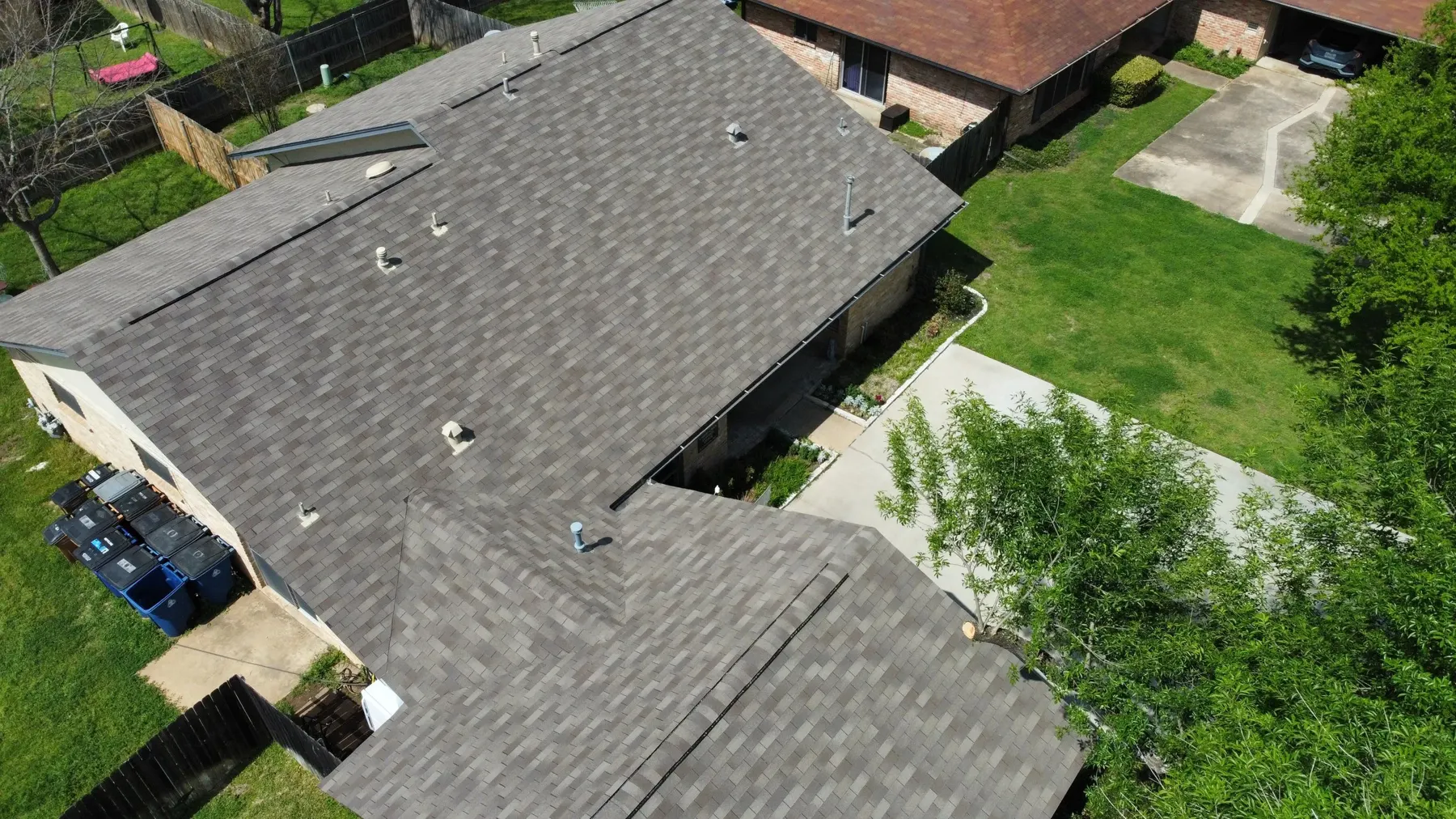
Colleyville Roof Repair: Stop the Leak, Then Find Out Why
A drip on the ceiling is the last stage of a roof problem, not the first. This guide walks through the order of a good repair and the weak spots Colleyville roofs tend to share.
Schedule Your Roofing Inspection Today
Fill out the information below and we’ll reach out to complete your estimate as soon as possible!


How a proper repair unfolds
Contain the water
Set out buckets, move what you can and photograph every stain. Wet drywall and insulation should be noted before they dry and hide the evidence.
Trace the path
Water often enters several feet uphill from where it drips. The attic tells more than the ceiling, so the search starts there. Our guide on how to find the source of a roof leak shows the method.
Cover if needed
If rain is coming and the opening is large, a temporary cover keeps it dry. For water actively pouring in, see emergency roof repair.
Repair the entry point
Replace the failed shingle, boot or flashing piece, seal it the way the manufacturer specifies and check the decking underneath.
Document the work
You should get photos of the damage and the finished repair, plus a written estimate that lists every part replaced.
Why Colleyville roofs reach the repair stage
Half of the homes in Colleyville were built before 1994 (U.S. Census Bureau, American Community Survey 2020-2024). That puts a typical house at around 32 years old. Most of those homes are on their second roof by now, and some are on a third. Each replacement adds new seams and penetrations where the old work meets the new.
Storms are the other driver. NOAA's Storm Prediction Center logged 190 hail reports within 10 miles of Colleyville from 2015 through 2024, and 37 of them were 1.75 inches or larger. Big stones crack shingles and dent metal flashing. The leak may not show until a long soaking rain finds the crack, which is why a storm can feel unrelated to a drip that starts months later.
Weak spots worth checking first
Chimney flashing
Step and counter flashing pull away as the chimney and roof move at different rates. Read more on leaks around chimneys and vents.
Plumbing vent boots
Rubber collars harden in the sun, split and let water run straight down the pipe into a wall or ceiling.
Ridge and hip caps
The highest shingles take the most wind. Cracked or missing caps open a line along the top of the roof.
Satellite and fixture holes
Old mounting holes left after a dish was removed are a common, easily missed entry point.
Dented metal
Hail can deform drip edge and valley metal so water no longer drains where it should.
When to ask about replacement instead
The same area has needed repair more than once.
Shingles are curling, cracking or shedding granules across most of the roof.
Decking feels soft when walked on, or daylight shows through boards in the attic.
Hail marks appear on several roof slopes, not just one.
Getting it fixed in Colleyville
GemSco is family owned and fully licensed and insured, with 20+ years of work on shingle, metal, tile and flat roofs. Estimates are free. If the repair visit shows the roof is near the end, roof replacement in Colleyville explains the next step. You can also read about our general roof repair service or see our work in Colleyville.
Frequently Asked Questions
Does a small stain mean a small repair?
Not always. A small stain can come from a long, slow leak that has already soaked insulation and decking. The size of the mark inside says little about the damage above it. The only way to know is to check the attic and the roof surface at that spot and uphill from it.
Can new shingles match my old ones?
Close, but often not exact. Shingle colors fade with sun and change from one production run to the next. On an older roof a patch may stand out. A contractor should tell you about the match before the work starts, not after.
Should I wait until hail season is over to repair?
No. An open crack or loose flashing lets water in during any rain, and Texas storms do not keep a calendar. Fixing the problem now protects the decking and the inside of the home. If another storm hits later, it can be inspected and documented on its own.
More Roofing Help in Colleyville
Roofing in Colleyville, TX
City overviewRoof Replacement in Colleyville
Learn MoreStorm & Hail Damage in Colleyville
Learn MoreRoof Inspection in Colleyville
Learn MoreCommercial Roofing in Colleyville
Learn MoreGutters in Colleyville
Learn MoreSolar Panel Installation in Colleyville
Learn MoreSolar Removal & Reinstall in Colleyville
Learn MoreRoof Repair Near Colleyville
We’re Here to Help!
GemSco Roofing & Solar serves Houston, DFW, Austin, San Antonio and surrounding areas. We’re family owned and fully licensed and insured.