

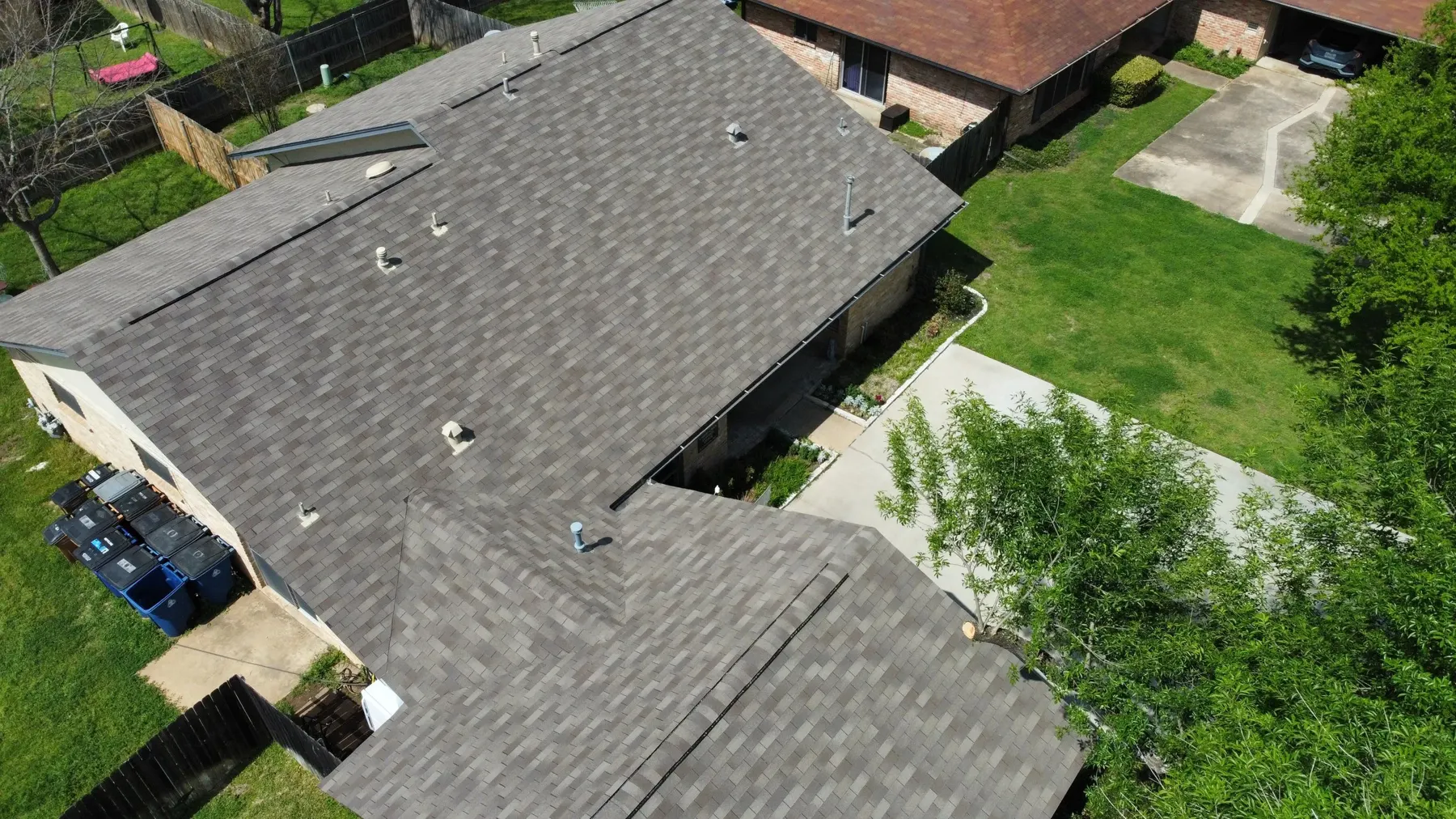
Commercial Roofing in Missouri City: Keeping Low-Slope Roofs Dry
For a business, a roof leak means more than a stain. It can shut down a room, damage stock and upset customers. Here is how to keep a flat roof working.
Schedule Your Roofing Inspection Today
Fill out the information below and we’ll reach out to complete your estimate as soon as possible!


Where commercial roofs fail
Seams
Joints between sheets of membrane open up with heat cycles and age, and water slips in.
Perimeter flashing
Edges, parapet walls and coping take the most movement and are a common leak point.
Penetrations
Pipes, vents and rooftop units each need flashing that stays sealed over time.
Drains and scuppers
Clogged outlets cause ponding, which adds weight and speeds up wear.
Foot traffic
Service crews walking to rooftop equipment can puncture or scuff the surface. Walk pads along common routes help protect the membrane.
Why low-slope roofs need a different approach
A pitched house roof sheds water in seconds. A low-slope commercial roof moves it slowly toward drains, so any dip, clog or open seam has more time to let water in. Insulation under the membrane can soak up a lot of water before a stain shows inside, and by then the repair area is much larger than the hole that caused it.
That is why commercial roof care is about routine, not just reaction. Small, regular checks cost far less than a tear-off of wet insulation. Read signs a commercial roof needs replacement to know what to look for between visits.
Systems used on low-slope buildings
Single-ply membranes such as TPO and EPDM, sealed at the seams. See TPO vs. EPDM roofing.
Modified bitumen, built from layered asphalt sheets.
Metal panels where the pitch allows water to run off.
Roof coatings, a general market option applied over some existing roofs when the base is still sound.
Storms and drainage in Missouri City
Missouri City lies in both Harris County and Fort Bend County, and business properties on either side face the same Gulf Coast weather. NOAA's Storm Prediction Center logged 14 hail reports within 10 miles of the city from 2015 through 2024, three of them 1.75 inches, in 2015, 2016 and 2017. On a flat roof, hail that size can crush insulation boards under the membrane and crack seams without leaving marks you can see from the ground.
Heavy rain is the more frequent test. A low-slope roof depends on drains and scuppers to move water off quickly. When one clogs during a downpour, water spreads toward the edges and into any weak seam. Our article on flat roof drainage systems covers how drainage is designed and kept clear.
A maintenance routine that works
Twice-yearly walk
Check seams, flashing and drains in spring and fall, and after big storms.
Clear the outlets
Remove leaves, trash and debris from drains and scuppers before the rainy months.
Track ponding
Note where water stands two days after a rain and how large the area is.
Fix small things fast
A small puncture or open seam is cheap to fix before water reaches the insulation.
Keep a log
Record every repair and inspection. A commercial roof maintenance plan helps you stay on schedule.
Working with GemSco
GemSco handles residential and commercial roofing, including low-slope and flat roofs, metal and shingle roofs on commercial buildings. We give free estimates and plan work around your hours where we can. Learn more on our commercial roofing page or visit our Missouri City roofing page.
Frequently Asked Questions
How often should a commercial roof be inspected?
Many owners schedule an inspection twice a year, in spring and fall, plus a check after any hail or strong wind. Regular checks catch open seams, clogged drains and damaged flashing early, when they are simple to fix. Keep the reports together so changes over time are easy to spot.
Can work be done without closing my business?
Often, yes. Most roof work happens outside the building, and crews can plan noisy work or material deliveries around busy hours. Areas below a section being worked on may need protection. Talk through your schedule and access needs before the job starts so the plan fits how your business runs.
When should a flat roof be replaced instead of repaired?
Replacement makes sense when leaks keep coming back in different areas, when insulation under the membrane is soaked across large sections, or when the membrane is brittle and cracking widely. If problems are limited to seams or flashing, repair is usually the better value. A roof inspection shows which case you are in.
More Roofing Help in Missouri City
Roofing in Missouri City, TX
City overviewRoof Repair in Missouri City
Learn MoreRoof Replacement in Missouri City
Learn MoreStorm & Hail Damage in Missouri City
Learn MoreRoof Inspection in Missouri City
Learn MoreGutters in Missouri City
Learn MoreSolar Panel Installation in Missouri City
Learn MoreSolar Removal & Reinstall in Missouri City
Learn MoreCommercial Roofing Near Missouri City
We’re Here to Help!
GemSco Roofing & Solar serves Houston, DFW, Austin, San Antonio and surrounding areas. We’re family owned and fully licensed and insured.